Prices and payment
How should you price a tuning file?
Per file, per stage, by vehicle or by credits: how file services set prices that customers understand and that still pay for the bad days.
In short
Price by what the work costs you: a base price per stage, adjusted by vehicle type and ECU, with extras listed. Show the price before the customer pays, and let good customers earn better rates instead of haggling.
Most file services set their first prices by looking at the competition and knocking a bit off. It works until the first bad month. A price has to pay for the easy jobs, the hard jobs, the corrections, and the Saturday you spent on one car.
What does a file really cost you?
More than the tuner's minutes on that one job. Add the tool subscriptions and protocols, the editor, the corrections you do for free, the time spent answering questions, the jobs you turn down after looking at them, and your portal. Divide that by the files you do in a normal month, and you have the number your prices must clear before you make anything.
What should the price depend on?
Things the customer can see, so it feels fair:
| What changes | Why |
|---|---|
| The stage or work | More maps, more time, more risk |
| Vehicle type | A truck or tractor takes longer than a car |
| The ECU | Some families are slow to work on or need more care |
| Speed | Express and Urgent jobs push others back |
| Volume | Customers who bring many files cost you less per file |
On a portal, your price list holds your prices per ECU and per vehicle type, with tiers for your best customers, promo codes and bundles, and the customer sees the right price on the order page.
Should you charge per file or sell credits?
Most services end up offering both. Pay-per-file suits a customer you see now and then, while credit packs suit the regulars and bring your money in earlier. See credits or card for how they compare.
If a customer has to ask for your price, you have already made it harder to buy from you.
Should you publish your prices?
Publish enough that a stranger can tell whether you are in their range. Customers tend to assume that a hidden price is a high one, or that it will depend on how they ask. Showing it on the order page also ends the conversation that used to take ten messages.
How do you handle customers who haggle?
Give them a rule instead of a discount. A tier for customers above a certain number of files, or a bigger credit pack with bonus credits, rewards what you want without undercutting everyone else. It also means two customers on the same volume pay the same, which matters when they talk to each other. They will.
How often should you change your prices?
When your costs change or when your queue is always full. A long queue is usually a sign you are too low. Raise prices for new customers first, and tell your regulars well ahead, because a good customer will accept a fair rise with notice and will never forgive a surprise.
Questions
Should I charge less for a repeat file?
You can, but most services do not. The customer is paying for the result, and your library is why you are fast.
Should corrections be charged?
A correction to your own work should normally be free. Say so, because it is why customers trust you.
Should I show prices before sign-in?
Enough to show your range. A workshop should be able to tell whether you suit them before making an account.
Just need a file tuned? Our own engineers tune a read from any tool for £50 a file, every extra included. Our file service ›
Read next
-
 Credits or card: how should customers pay for files?Credit packs bring money in early and suit regulars; card per job suits everyone else. How to run both without confusing anyone, and what to watch out for.
-
 How do you stop chasing payment for tuned files?Late payers cost a file service more than discounts ever do. How to get paid before the work, without offending good customers or losing the regulars.
-
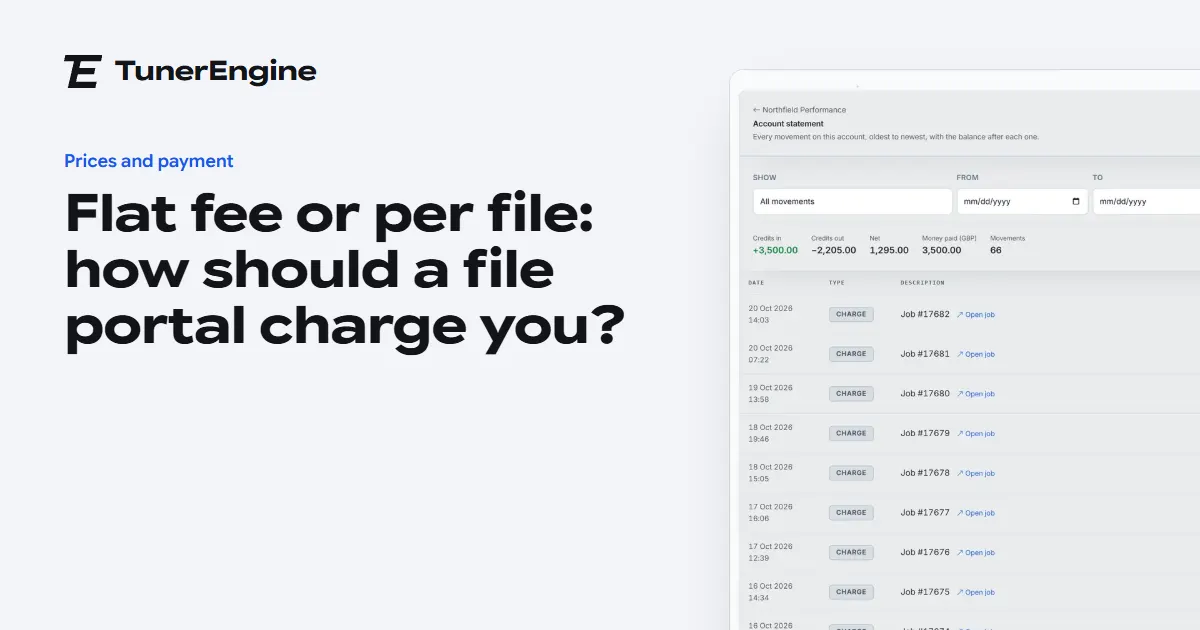 Flat fee or per file: how should a file portal charge you?The three ways file portals charge, and how each behaves when you are small, when you grow and in a slow month. How to work out which suits your shop.
Name your portal. It is ready in under a minute.
Pro: today you pay this month in full, or only the days left if the 1st is less than 10 days away; then £49.99 on every 1st.
- Your name and logo
- Files from any tool
- Updates done for you
- Moving from another portal, free