Prices and payment
Credits or card: how should customers pay for files?
Credit packs bring money in early and suit regulars; card per job suits everyone else. How to run both without confusing anyone, and what to watch out for.
In short
Offer both. Card per job suits a customer who comes now and then, and credit packs suit regulars and bring your money in before the work. Set one credit to a clear value, and let bigger packs earn bonus credits.
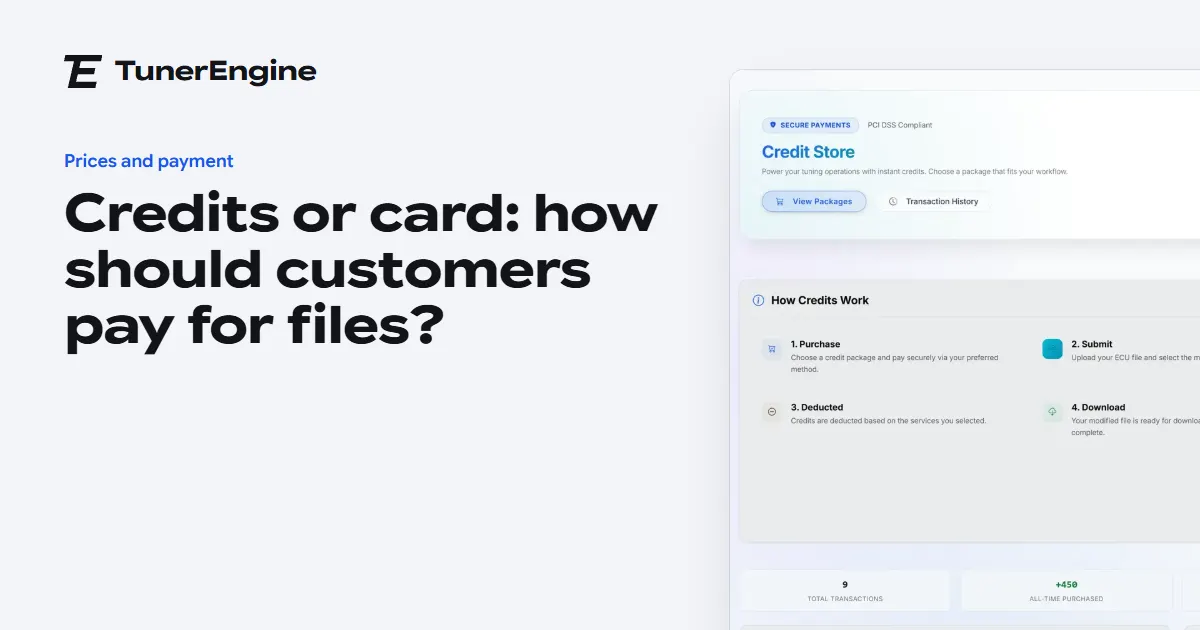
A file service gets paid in one of three ways: on an invoice afterwards, by card per job, or from credits bought in advance. Only the last two pay you before the work is done, and they suit different customers.
How do the two compare?
| Card per job | Credit wallet | |
|---|---|---|
| Who it suits | Occasional customers | Regulars and workshops |
| When you get paid | Before the job | Before many jobs |
| Card fees | On every job | On each top-up |
| Friction | Pay every time | One click from credits |
| Reward for loyalty | None built in | Bonus credits on bigger packs |
Why do workshops like credits?
Because they sit beside a car and do not want to dig out a card for each job. Credits also let a manager top up once and let the staff work, and a pack with bonus credits gives them a better price without a conversation about discounts.
Why do file services like credits?
The money arrives first, which smooths out a business that swings from week to week. A customer holding credits also tends to come back to you and not shop around for each job, because their money is already with you. Fewer top-ups than jobs also means fewer card fees.
A customer with credits on your portal has already decided who the next file goes to.
What are the traps with credits?
Keep them simple. One credit should be worth a clear amount, ideally one unit of your currency, so nobody needs a calculator. Be clear about whether credits expire, and write it down before anyone asks. Remember too that credits are money you have taken for work not yet done: keep track of them, and ask your accountant how they should be treated and when VAT applies, because this differs between countries.
How do you run both without confusion?
Let the customer choose on the order page. They see the price, then pay by card for that job or from their wallet if they have enough. Every top-up and every job gets an invoice without anyone typing one. On a TunerEngine portal, payment first means a request only goes through once it is paid, whichever way they choose, and the money lands in your own payment account.
Should you still offer invoices afterwards?
For a few customers you know well, perhaps. A large account may need it for their own bookkeeping. Treat it as a privilege you give after someone has proved themselves, and not as the way everyone pays, because the customers who pay late are rarely the ones who make you the most money. Chasing payment covers how to end it.
Questions
What should one credit be worth?
One unit of your currency is easiest. Customers can then read every price without a calculator.
Can a customer see their balance?
Yes. It is on their portal, along with what they have bought and spent.
Do bonus credits cost me margin?
They do, deliberately. You give a little on each file in return for money up front and a customer who stays.
Just need a file tuned? Our own engineers tune a read from any tool for £50 a file, every extra included. Our file service ›
Read next
-
 How should you price a tuning file?Per file, per stage, by vehicle or by credits: how file services set prices that customers understand and that still pay for the bad days.
-
 How do you stop chasing payment for tuned files?Late payers cost a file service more than discounts ever do. How to get paid before the work, without offending good customers or losing the regulars.
-
 How does VAT work when you sell tuning files in Europe?Selling files to businesses and to people across borders: the usual VAT rules in plain words, what a portal can do for you, and when to ask your accountant.
Name your portal. It is ready in under a minute.
Pro: today you pay this month in full, or only the days left if the 1st is less than 10 days away; then £49.99 on every 1st.
- Your name and logo
- Files from any tool
- Updates done for you
- Moving from another portal, free